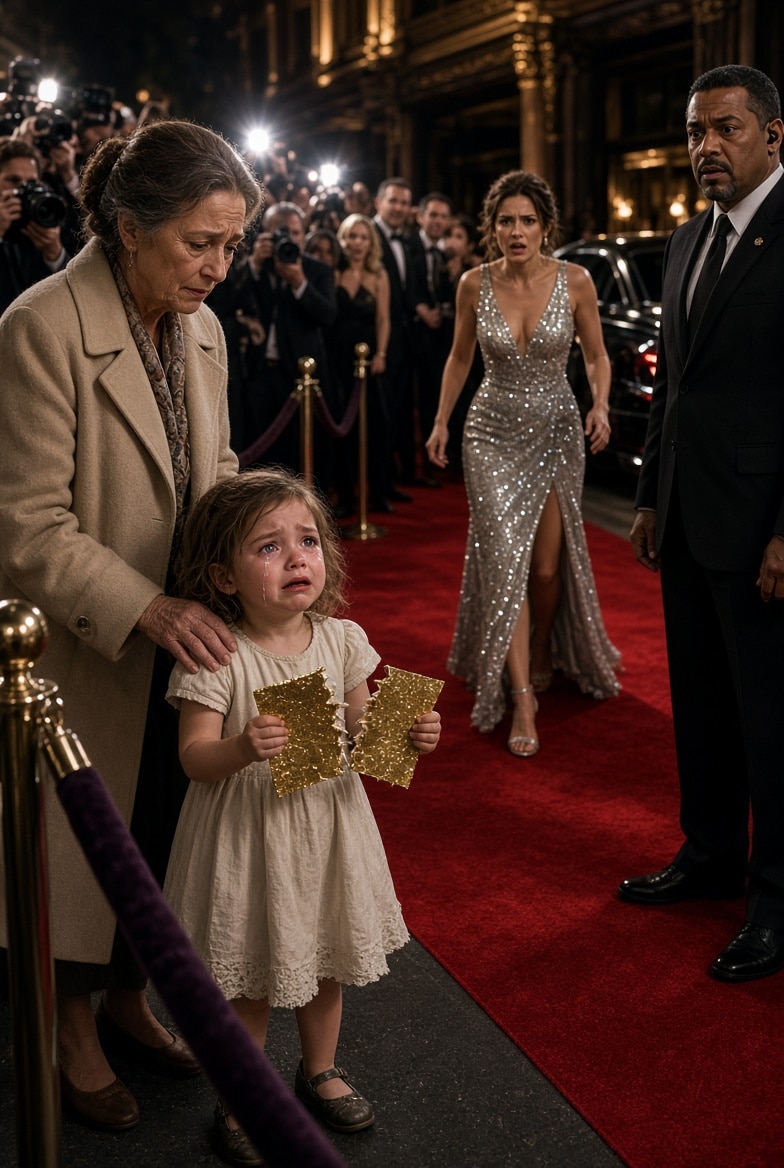
The first thing Hollywood ever taught me was that cruelty looked better under expensive lighting.
By the time my limousine reached the premiere, the entire block had been bleached into an artificial version of night. White towers washed the theater facade until every crack in the old stone disappeared, camera flashes burst against the barricades in nervous waves, and hundreds of people stood beneath enormous photographs of my face while pretending they had come only to see a movie. Through the smoked window beside me, I watched assistants run along the carpet with headsets pressed to their ears and security men reposition velvet ropes by inches, moving human bodies with the same precision other people used to arrange furniture.
My stylist had spent forty minutes making sure the silver dress fell perfectly across my hips. A jeweler’s representative had fastened a diamond necklace around my throat and reminded my publicist twice that the piece was insured for more money than the house where I grew up. Someone had powdered the skin between my collarbones because the sponsor’s photographer disliked shine, while somebody else had checked my teeth for lipstick before the car door opened. I had long ago learned that being looked at by millions of people required an astonishing amount of work to make it appear that nobody had touched you.
Maisie had texted me twenty-seven minutes earlier.
We’re here!!! Grandma says I’m using too many exclamation points.
I had smiled when I read it. Ruth had been policing punctuation since I was twelve, despite being perfectly willing to send me six question marks whenever I failed to answer my phone, and I could picture the expression she would have made while Maisie typed beside her. They had flown in from West Virginia that morning for the first Hollywood premiere either of them had ever attended, and I had spent the previous week checking their travel arrangements myself because I no longer trusted excitement to survive professional handling.
The final message from Maisie included a photograph taken inside the hotel elevator. She wore the pale blue dress we had chosen together over video, the kind of department-store dress that cost less than one sleeve of what I was wearing, and Ruth stood beside her in the camel-colored coat she had owned for as long as Maisie could remember. Ruth’s silver hair had been brushed neatly behind her ears, and she held up two fingers in the little victory sign she used whenever she disliked having her photograph taken but understood resistance was pointless.
I stared at that photograph until my publicist, Maren Holt, gently touched my knee.
“Nora, they’re ready for you. We are already four minutes behind the studio schedule, and Cartier wants the necklace visible in the first full-length shots before you turn toward the cast wall.”
Maren was good at her job because she could say sentences like that without sounding absurd. She had spent twelve years translating corporate priorities into human instructions, and I had spent the last six learning how to follow them without visibly checking where one person’s wishes ended and another person’s ownership began. I handed her my phone before the door opened, because phones ruined silhouettes, and placed my fingers around the cool metal handle.
“I need five minutes with Ruth and Maisie before we go inside. They should be coming through family check-in now.”
Maren glanced toward the production assistant outside the car. “I’ll have someone locate them and bring them to the family holding area. Stay on carpet first, because if you leave your position once you’re out there, we’ll have fifteen photographers screaming at the wrong people.”
I should have insisted.
That thought would return to me later with such persistence that it became difficult to distinguish memory from punishment. At the time, however, the instruction sounded ordinary, and ordinary instructions were the reason my life worked at all. I nodded, the door opened, and a hundred people shouted my name before both of my feet reached the pavement.
I had been famous for three years by then, which was long enough to know that photographers did not really call your name because they wanted your attention. They used it the way fishermen used movement on a line, pulling your eyes toward whichever lens had the best angle and keeping your face turned long enough to make their image different from the twenty other images taken in the same second. I gave them the version of Nora Bellamy they expected: chin slightly down, shoulders loose, smile warm enough to suggest pleasure without looking overeager, one hand placed where the jeweler had requested so the necklace remained unobstructed.
There had been a time when attention made me shake. That evening, the machinery of it felt almost soothing because every expectation had been rehearsed, and rehearsed expectations were easier than real people. I moved from mark to mark as assistants guided me beneath sponsor logos, answered two harmless questions about the film, and let an entertainment reporter tell me I looked “effortlessly radiant” after six people had spent most of the afternoon manufacturing the effortlessness.
Then I saw Ruth.
She was standing beyond the second velvet rope near a sponsor entrance, half obscured by a group of guests waiting to be photographed against the branded wall. Even from twenty yards away, I recognized the way she held her shoulders when somebody was speaking to her as though she were slow rather than unable to speak. Her chin lifted slightly, her hands remained controlled at waist level, and she watched the other person’s mouth with the patient concentration she had developed after decades of strangers assuming silence meant confusion.
Maisie stood beside her.
The pale blue dress looked softer beneath the hard carpet lighting, and her hair had already begun losing the curls the hotel stylist had offered to fix for free. She was holding both family credentials in one hand and Ruth’s fingers in the other, while a woman in a black sponsor-issued suit examined them with an expression I knew immediately. It was the expression people used when they had already decided the answer and were continuing the conversation only because procedure required another thirty seconds.
A reporter asked me something about working with the director.
I smiled at him automatically.
I have no memory of what I said.
The woman speaking to my family was Lydia Crane, regional events director for one of the luxury sponsors. I had met her earlier that week during a rehearsal walk-through, when she had been perfectly pleasant and had spent ten minutes explaining how important “authenticity” was to the brand’s relationship with artists. From where I stood now, I watched her glance at Ruth’s coat, then at Maisie’s shoes, before returning her attention to the credentials in Maisie’s hand.
Something in my stomach tightened.
I turned slightly away from the photographer in front of me.
Maren appeared at my elbow before I could move.
“Nora, center camera first. Then I’ll find out what’s happening.”
I looked at her. “That’s my grandmother.”
“I know. Give me thirty seconds.”
Thirty seconds had built my entire career.
Thirty seconds while somebody checked with an executive. Thirty seconds before the car arrived. Thirty seconds while an assistant asked whether the producer was in a good mood. Thirty seconds outside doors where people with more power than I had decided whether I was worth remembering. I had become extraordinarily good at surviving thirty seconds.
Maisie had not.
Lydia spoke to a security supervisor, then pointed toward a narrow passage beside the theater where catering employees and technical crews had been moving throughout the evening. I could not hear her yet, but Maisie’s face told me enough. Her cheeks flushed first, then her mouth tightened, and she looked at Ruth the way she had looked at me as a child whenever she was trying not to cry in front of strangers.
I left my mark.
Several photographers immediately called for me to turn back.
Maren caught my arm without gripping it.
“Nora, let me handle this before you create something we cannot undo.”
Her voice was low, almost gentle, and the sentence frightened me more than it should have. In my world, anything that could not be undone usually mattered more than anything already happening to someone else.
I stepped away from her.
By the time I reached the rope, Lydia was speaking loudly enough for the nearest guests to hear.
“These credentials are for family access, but this section is sponsor-facing and already overcrowded. We can route you through service and bring you inside without creating a scene.”
Maisie stared at her.
“We didn’t make a scene. We just got here.”
Her Appalachian vowels were softer than mine used to be, but they were still unmistakable. I heard them catch against the polished accents around her and felt an old, involuntary shame move through my body before anger crushed it. For years people had paid coaches to remove those sounds from my mouth, and now I heard them in my sister’s voice as if someone had opened a room inside me I had spent too long keeping locked.
Lydia gave her a restrained smile.
“I’m not saying you did anything wrong. I’m saying there is a more appropriate entrance for family members who aren’t participating in sponsor photography.”
Ruth raised both hands.
I knew the signs before she finished them.
WE WERE TOLD THIS ENTRANCE. ASK NORA.
Lydia watched without understanding.
Maisie translated.
“My grandma says Nora told us to come here. Nora Bellamy. She’s my sister.”
A man behind them laughed quietly.
I turned toward the sound and recognized a lifestyle influencer whose team had spent most of the week negotiating carpet placement as though international diplomacy depended on it. He leaned toward the woman beside him and murmured something I could not hear, but both of them looked at Ruth’s coat afterward.
Lydia’s patience thinned.
“Everyone outside this rope knows somebody tonight. I am not questioning your story, sweetheart, but this is a controlled area and I need you to cooperate with the staff.”
Maisie’s grip tightened around the credentials.
“She isn’t a story. She’s my grandma.”
That sentence landed harder than anything else had.
Ruth touched Maisie’s forearm and signed slowly enough that my sister could not pretend she had misunderstood.
LET’S GO HOME.
Maisie shook her head, eyes shining now.
Ruth signed again.
THIS IS NOT WORTH IT.
I was close enough by then to see the small details people on the carpet would never notice: the frayed seam near one pocket of Ruth’s coat, the pale indentation where Maisie had bitten the inside of her lip, the slight tremor in Ruth’s left hand that appeared whenever she was trying very hard not to show anger. Those details belonged to the world I came from, a world where dignity was often the only thing available when money, status, and access belonged to somebody else.
Lydia finally noticed me.
Her entire face changed.
“Nora. I was just trying to redirect your family through the private service route because this section is extremely congested, and I didn’t want your grandmother or sister caught in the sponsor line.”
The explanation was smooth enough that I understood immediately why she had reached her position. She had not said Ruth looked poor. She had not called Maisie a liar. She had not explicitly said they were embarrassing. Every insult had been translated into logistics, which was the language powerful people used when they wanted cruelty to sound like efficiency.
Maisie looked at me.
Her expression contained relief, humiliation, and something worse beneath both: uncertainty over whether I would agree with the woman in the expensive suit.
I had seen that uncertainty before.
Years earlier, when Maisie was small enough that her feet did not touch the floor from a kitchen chair, she had learned to look at me whenever someone treated Ruth badly because I was the one who could speak aloud. I had been twelve when our family began depending on my voice, and the habit had never entirely left us. Even after money changed everything else, some part of Maisie still expected me to be the person who explained to the world that Ruth understood perfectly well, that silence was not stupidity, that our family did not need permission to exist in a room.
I looked at Lydia.
“What exactly did you mean by ‘service route’?”
She maintained the professional smile.
“The corridor on the east side. It would get them inside faster and keep them away from the photo congestion. I thought it would be more comfortable for everyone.”
“For everyone?”
Lydia hesitated.
Behind me, photographers had begun turning their cameras toward the conversation. Maren was approaching quickly now, accompanied by a studio publicity executive whose face had already acquired the pale concentration of a person calculating consequences.
Lydia lowered her voice.
“Nora, I’m trying to protect the carpet. They’re not styled for sponsor photography, your grandmother clearly isn’t comfortable with press interaction, and your sister is a minor. If we move them through service, it keeps the visual cleaner and gets them seated without any unnecessary attention.”
Cleaner.
Of every word she could have chosen, that was the one she gave me.
For a moment I was eighteen again, standing inside my first Beverly Hills party in a borrowed dress while people who had never missed rent decided whether my accent made me charming or cheap. I remembered learning which fork to pick up only after watching the woman beside me, lowering my voice because somebody told me Appalachian women sounded “harsh” on tape, and smiling when an agent suggested I stop mentioning West Virginia unless an interviewer specifically wanted a poverty story. I had spent years becoming visually clean enough for rooms like this one.
Now my sister stood in front of me wearing a seventy-dollar dress.
My grandmother wore the coat she had bought before I booked my first speaking role.
And the industry that had spent years sanding every visible trace of where I came from had finally looked at the two people I loved most and called them clutter.
I reached behind my neck.
Maren understood before Lydia did.
“Nora, don’t.”
The clasp of the diamond necklace was tiny and difficult to manage with cold fingers. A jeweler’s representative hurried toward us when she saw what I was doing, but I kept working until the weight lifted from my throat. I placed the necklace in Maren’s palm, watching her close her fingers around several million dollars of somebody else’s property.
“What are you doing?” she asked quietly.
I looked toward the sponsor wall where my name, my film, and Lydia’s brand had been arranged together as though none of us could exist independently.
“I’m making the carpet cleaner.”
Maren’s eyes closed for half a second.
I turned toward Lydia.
“My grandmother does not need to speak for you to treat her like an invited guest. My sister does not need a stylist for you to believe the credential in her hand. They flew across the country because I asked them to be here, and you were about to send them through the same corridor used for equipment because their clothes made you nervous about photographs.”
Lydia’s jaw tightened.
“That is not what I said.”
“You said it would look cleaner.”
Several cameras were close enough now that I could hear shutters operating continuously.
Lydia glanced toward them.
“I said the carpet would be easier to manage if your family used the private route. Please do not turn an operational decision into something it was never intended to be.”
That was another sentence I knew too well.
Intent.
Hollywood loved intent because intent lived inside people where cameras could not record it. Contracts recorded actions, emails recorded language, money recorded ownership, but intent remained private enough for everyone to claim innocence after the damage was visible.
I looked at Maisie.
She had started crying without making any sound. Tears moved over her flushed cheeks while she kept both credentials pressed against her stomach, and the sight produced an old kind of anger in me, one connected to every moment I had arrived too late to help her. I wanted to tell her that I had built all of this so nobody would ever look at her that way again, but the sentence would have been obscene while she stood on the wrong side of a velvet rope at my premiere.
I held out my hand.
“Come here.”
Maisie did not move immediately. She glanced toward Ruth, who watched me with the expression she had worn through almost every terrible decision of my adolescence: fear carefully hidden beneath trust.
I signed to her.
COME WITH ME.
Ruth’s eyes moved toward the cameras.
YOUR WORK.
I understood what she meant. She was reminding me that dozens of people depended on this premiere, that leaving the sponsor position could create consequences beyond my own reputation, and that Ruth had spent most of my life refusing to become the reason I surrendered an opportunity.
I signed again.
YOU ARE MY FAMILY.
Her mouth tightened.
Then she asked the question with her hands.
AND TOMORROW?
I had no answer.
That was the part no camera could capture.
It was easy to choose family with two hundred lenses watching.
Tomorrow would be meetings, phone calls, contracts, damage assessments, and people explaining how one impulsive gesture had affected commitments worth more than Ruth’s house had cost several times over. Tomorrow the industry would ask whether I had meant to insult a sponsor, whether the brand relationship remained viable, whether my behavior created insurance concerns, whether the actress they had invested in was becoming difficult.
Ruth knew that.
She had watched me pay for every rung of the ladder even when I refused to tell her the exact currency.
Maisie looked between us.
“I don’t want you to get in trouble because of me.”
Her voice broke slightly on the final words, and something inside me went cold.
I had spent years hearing versions of that sentence from the people I loved. Ruth did not want to make my schedule difficult. Maisie did not want to interrupt an interview. Somebody at home always understood that Nora had work, Nora had meetings, Nora had people waiting, Nora had crossed too much distance to turn around now.
For once, I hated the understanding more than I hated the humiliation.
I stepped over the velvet rope.
The security man beside Lydia instinctively raised one hand, then froze when he recognized who he was about to stop.
Photographers shouted my name.
I took Maisie’s hand with my right and Ruth’s with my left.
Lydia moved closer.
“Nora, please think about what this is going to look like.”
I met her eyes.
“That’s the first thing everyone here has been thinking about all night.”
I turned toward the carpet.
“If they don’t belong on it, neither do I.”
The noise changed instantly.
Before that moment, the crowd had been loud in the organized way premieres were loud, divided into predictable streams of names, interview questions, instructions, and applause. Now the sound became uncontrolled. Photographers surged against their marks, reporters called over one another, studio staff began moving toward us from three directions, and phones lifted behind the barricades as guests realized something unscripted had finally happened.
Maisie’s fingers became painfully tight around mine.
I felt her hesitate.
“Just walk with me,” I told her. “You do not have to look at anybody you don’t want to look at, and you do not owe one person here a smile.”
Ruth touched my arm and signed with her free hand.
SLOW DOWN. SHE’S SCARED.
I slowed immediately.
That small instruction did more to steady me than anything Maren or security could have said. Ruth had spent my entire life bringing me back to whatever human being existed beneath the emergency, and even now, when she had every right to be furious, her attention remained on Maisie’s breathing.
We moved onto the carpet together.
I could feel Maisie trying to make herself smaller beside me, shoulders slightly rounded and chin lowered whenever someone shouted her name after learning it from another reporter. I hated the speed with which the machinery adapted. Five minutes earlier, she had been undesirable background; now she was content. Photographers who would not have known her from any other child began calling for her to move closer to me, turn toward the light, lift her face, show the dress, hug her sister.
I stopped at the first photo mark only because Maisie stopped.
She looked at the photographers, then at me.
“Do I have to?”
“No.”
She exhaled.
Ruth squeezed her hand.
For a few seconds, neither of them moved into the positions the photographers requested. I stayed where they stayed, forcing everyone else to adjust around us. The image that eventually traveled around the world was not the one any sponsor had planned: Ruth in her old coat, Maisie with tears still visible on her face, and me standing between them without the diamond necklace the brand had paid to place around my throat.
People later called the photograph defiant.
I remember feeling ashamed.
Not of them.
Of how familiar their embarrassment looked to me.
The three of us reached the end of the carpet nearly fifteen minutes later. Maren had managed to prevent most reporters from physically closing in, and the studio moved us into a private lounge before the screening began, where somebody brought water nobody drank. Maisie sat on a sofa beside Ruth and stared at her credentials as though she still did not trust them.
I removed my shoes because my feet had begun to ache.
The room became quiet enough for the muffled noise outside to sound unreal.
Ruth took a small notepad from her purse, although she rarely used paper with me anymore. She wrote slowly, then turned it toward me.
YOU DID NOT HAVE TO DO THAT IN FRONT OF EVERYONE.
I read it twice.
“I know.”
She wrote another sentence.
I AM GLAD YOU DID IT FOR HER. I AM WORRIED YOU HAD TO DO IT FOR YOURSELF.
That was Ruth’s way. She could not speak, but she had never needed many words to find the place I was hiding from.
Maisie looked toward me.
“Are they going to fire you?”
Despite everything, I laughed.
“No. Actors don’t usually get fired from movies after the movie is already finished.”
She considered that carefully. “Are they going to be mad?”
“Yes.”
“How mad?”
I leaned back against the sofa and looked at the ceiling. “Probably the expensive kind.”
That made her smile for the first time since I found them outside.
Ruth tapped the table twice to bring my attention back to her hands.
YOU ARE JOKING. YOU ARE AFRAID.
I looked away.
There were things Ruth knew because she had raised me and things she knew because fear changed my body in the same ways it had when I was poor. My shoulders became too still, my fingers searched for objects to straighten, and I started making jokes before anyone else could name what was wrong. Fame had altered almost every external measurement of my life, but terror still used the same entrances.
Maren entered several minutes later.
She had removed her headset and looked older without it.
“The good news is that the video is already everywhere, and public reaction is overwhelmingly on your side. The bad news is that the sponsor considers the necklace removal a deliberate rejection of the placement agreement, and Lydia is telling people she was trying to protect your family’s privacy rather than exclude them.”
I watched Ruth’s expression change at the word privacy.
Maren noticed too.
“I’m not saying I believe her version. I’m telling you what we are going to be dealing with after the screening.”
Maisie lowered her eyes.
I reached across and covered her hand with mine.
Maren continued only after she saw the gesture.
“The studio wants you inside before the opening remarks. They will seat Ruth and Maisie beside you if that is still what you want, and nobody is going to challenge their credentials again tonight.”
“If that is still what I want?”
Maren exhaled.
“Nora, I am choosing my words carefully because you are angry and because your family has been treated badly. You also need to understand that you just created a global news cycle during the launch of a film with hundreds of millions of dollars attached to it. I am not telling you to apologize. I am telling you that every person in this building is about to decide what your gesture means for them.”
I knew she was right.
That was the worst part.
Hollywood had taught me to recognize when somebody was exploiting me, but it had also taught me that exploitation could coexist with legitimate obligations. The studio had employees, investors, distributors, crews, and partners whose lives could not be reduced to villains simply because one sponsor representative had looked at my grandmother’s coat and decided she belonged near a service corridor.
I looked at Maisie.
She was tracing one thumb over the raised lettering on her credential.
“What do you want to do?” I asked.
She glanced toward Ruth, then back at me.
“I still want to see your movie. I came all this way.”
“Then we’re watching it.”
Maren nodded and started toward the door.
Before she reached it, Ruth lifted one hand.
Maren stopped.
Ruth signed to me, expecting translation.
TELL HER THANK YOU FOR NOT LYING TO YOU.
I translated.
Maren looked surprised.
Then Ruth continued.
TELL HER THAT DOES NOT MEAN SHE GETS TO DECIDE FOR YOU.
Maren gave a tired smile that contained more respect than offense.
“I think I understood that part without translation.”
For the first time that night, Ruth smiled too.
We entered the theater through an interior corridor rather than returning to the carpet. I sat with Maisie on my right and Ruth on my left, which meant that for nearly two hours I could feel both of them beside me whenever the audience laughed, gasped, or applauded. Maisie whispered twice during the opening act to ask whether a scene had really been filmed in Paris, then covered her mouth because she thought she had broken some rule about talking during my movie.
I barely saw the film.
I had watched every scene too many times already, but that was not why. My attention kept returning to the feel of Maisie’s shoulder against mine and the realization that I had spent years chasing rooms grand enough to impress her, only to discover that the first time she entered one, it made her feel ashamed of where we came from.
Halfway through the film, she leaned closer.
“You looked scared when that lady said we should go around the side.”
I turned toward her.
“I was angry.”
“You looked scared too.”
Children become dangerous observers when adults forget they are watching.
I took several seconds before answering.
“I was scared.”
“Of her?”
The question would have been easier if the answer were yes.
“No. Of everything that comes after people like her decide you’re difficult.”
Maisie frowned because the explanation belonged to a world she had not entered yet. I was grateful for that confusion. Ruth touched my wrist in the darkness and signed against her own palm so the movement would remain small.
ENOUGH FOR TONIGHT.
She was right.
Maisie did not need my confession before she had even finished watching my face on a screen thirty feet high.
I turned back toward the film.
The audience applauded when the credits began, and I stood when I was supposed to stand. I smiled when the director hugged me, thanked the cast, thanked the studio, and allowed people to photograph me with Ruth and Maisie in the aisle. By the time we reached the private exit, the story had already transformed into something cleaner than what actually happened.
MOVIE STAR DEFENDS MUTE GRANDMOTHER AND LITTLE SISTER.
NORA BELLAMY WALKS OFF SPONSOR CARPET AFTER FAMILY HUMILIATED.
HOLLYWOOD’S MOST POWERFUL SISTER?
I read the headlines in the back seat while Maisie slept with her head against Ruth’s shoulder.
People loved the story.
They loved the clarity of it.
A cruel woman had insulted my family, and I had chosen love over luxury. The necklace came off. The sister took my hand. The mute grandmother walked beside us. The cameras recorded justice before the movie even started.
Nobody knew how badly I wanted to believe that version.
Nobody knew how many times Maisie had needed me before there were cameras.
Nobody knew how often Ruth had watched me return home with expensive gifts because gifts were easier to deliver than time.
Nobody knew what I had already agreed to, swallowed, rewritten, or allowed other people to rename in order to reach a point where walking off a sponsor carpet looked brave instead of career-ending.
Everyone thought that was the night I chose my family over Hollywood.
They were wrong.
I had chosen Hollywood over them in smaller ways for years, and one beautiful photograph could not reverse the arithmetic.
My phone vibrated in my hand.
The number was not saved.
I recognized it anyway.
I had deleted Graham Kessler’s contact eighteen months earlier, but forgetting his number would have required forgetting the years of my life during which seeing it appear on a screen could change the temperature of an entire room.
The message contained no greeting.
Careful, Nora. Family makes you look human. Human makes you expensive to control.
I read it once and felt the muscles along my back tighten against the leather seat. Outside the window, Los Angeles moved past us in polished black glass and reflected light, while Ruth slept beside the sister I had promised my whole life to protect.
Another message appeared before I could lock the screen.
You should know better than anyone what it costs to stay inside the rope.
I turned the phone facedown against my thigh.
Maisie shifted in her sleep and reached blindly across the seat until her fingers found mine. I held on without waking her, listening to Ruth’s quiet breathing while the city carried us toward a hotel guarded by men who knew my name.
For the first time that night, the photographers were gone.
That was when I became afraid.
Leave a Reply